

Physical Therapy’s Solutions for Aging and Age-Related Pain
Physical Therapy’s Solutions for Aging and Age-Related Pain
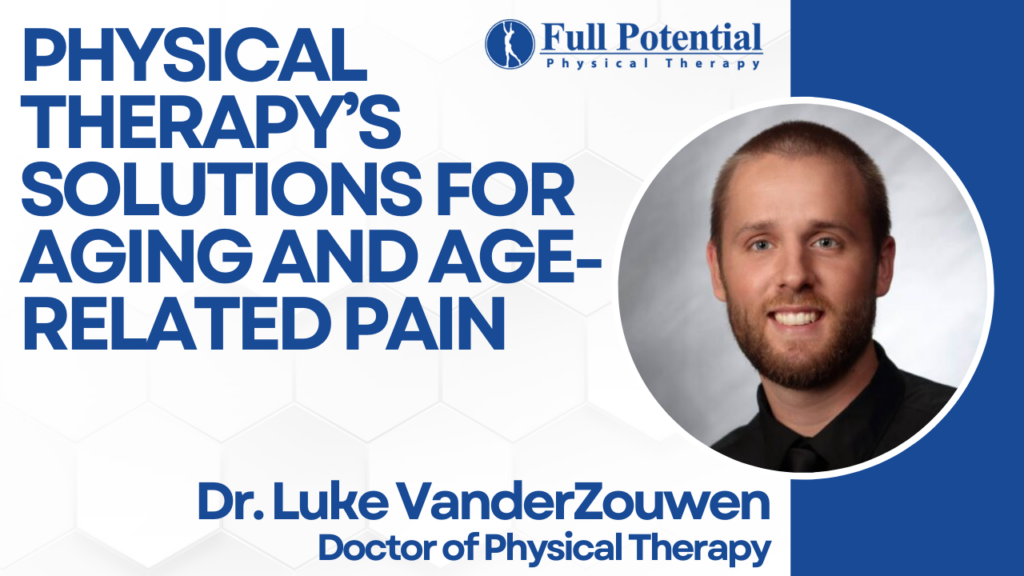
There are certain changes that happen as we age, everyone knows this. My name is Luke VanderZouwen, and I’m a physical therapist at Full Potential Physical Therapy. I’m here to talk to you today about the aging process and how physical therapy can help.
How Aging Changes the Body
We have all seen, as either relatives have gotten older or we ourselves have gotten older, there are some things that slow down or change with time. We see that across multiple body systems, including organ systems, the nervous system, and the musculoskeletal system.
Organ System Changes with Aging
With organ systems, certain organs tend to slow down a little bit. Our metabolism slows and things like digestion even take a little bit longer. There are a lot of different changes that happen in our organs as we age.
Nervous System Changes with Aging
The nervous system is another system that is affected. This would be the brain, spinal cord, and any of our peripheral nerves that run out into the rest of our body. Typically, what we see is nerve firing going a little bit slower, and things like memory and reaction changes can happen.
Musculoskeletal System Changes with Aging
If we move on to the musculoskeletal system, some of the changes are obvious. We’ve all seen people as they get a little bit older, they tend to develop some arthritic change. That would be oftentimes classified as a degenerative change within our bony system, but I like to think of it a little bit differently. Our body wrinkles on the outside, and we don’t call it “degenerative skin disease.” Well, our body wrinkles on the inside too, so we have some of these bony changes that occur.
Typically, there’s less muscle mass, and tissues that once were stretchier (think tendons, ligaments, even muscles) tend to be a little bit stiffer as we age. That just has to do with how our body goes through the aging process.
How Movement Can Improve Your Aging Process
That’s a lot of downers because there are some negative changes that happen with age. However, one of the common denominators for a lot of our different aging processes that occur is, movement can be helpful. Movement can be helpful for a lot of different things. We all have heard that exercise is a good thing; but exercise can be helpful for more than just our muscles, heart, and lungs, which are important.
It can also be helpful for some of our organs’ processes. For example, the GI system (how our bowels function and those types of things) can be helped with movement. And if we’re practicing movement on a regular basis, it can do things for our nervous systems like improve speed and reaction time, make some of our sensory perception a little bit sharper, and so on.
Those are just a few ways that movement can be helpful for the aging process and ensuring that we’re aging as well as we can with a really good quality of life, which is really what everyone wants. We all know we’re going to get older, but it’s quality of life as we age, that is what people are looking for.
Common Barriers to Effective Movement as We Age
Oftentimes though, there are barriers to moving well. One of the most common barriers that we see in the physical therapy world is pain. If the body is in pain, sometimes it doesn’t want to move; and when that’s been going on for long enough, it can start to have an effect on some of these body systems that change through the aging process.
Other barriers can include lack of strength and balance issues. If people are having issues with balance, they tend not to move near as much and that can have some other effects on the body. Another big barrier can be simply not knowing what to do. If you don’t know what to do when it comes to healthy movement practice, you’re probably not going to be moving as much.
What to Do if You Experience Barriers to Movement
If you’re thinking, “I want to be able to move better, because I want to have a positive impact on my aging process, but I don’t know how to do it,” or, “I have some of these barriers that are keeping me from doing it,” you should consider physical therapy. Physical therapists like me are trained to pick up on movement dysfunctions and come up with holistic plans to try to improve your movement quality.
The goal is to eventually improve function to help with quality of life long-term, even as we age. That can get complex, and sometimes it helps to have someone on your side that you can share your goals with and establish a plan to accomplish those goals.
Get Support to Reach Your Full Potential
If you’re noticing that you have some of these barriers to moving well and you’d like to move better, I highly encourage you to bring up physical therapy with your physician or call and schedule a consultation with a physical therapist. We’d be happy to do that here at Full Potential, and we can go over some of those goals and some of those issues that you might be having and determine if physical therapy is right for you. Give us a call at (616) 537-2837 to get started today.