
IT IS A “QUESTION OF BALANCE”

Vincent Hanneken, PT/Owner
By Vincent Hanneken, PT/Owner
This article is not about an old Moody Blues tune, although being lousy at it may give you the blues. Every day we engage in a routine action that can actually be a test on this key skill in life. What might that be? One simple example is getting dressed; an action common to nearly all of us, but how do we accomplish it? Is it a sitting down process for better control, or are you doing it standing leaning against a wall to stabilize or can you still do it without any support while standing?
Yes, we are talking about balance, that quality we only seem to recognize it has changed when suddenly it is needed or it has degraded as a result of an injury or surgery.”
Sprain an ankle and see how that disrupts the ability to stand on one foot and be in good control. And, to just bring this home to right now. I had a friend who recently lost her balance and fell, breaking her arm; she now needs surgery but is having to wait a week because so many people have fallen recently requiring surgery. Combine winter conditions with someone with poor balance and we have the perfect storm for a fall.
Being able to control one’s balance in a variety of situations is one of the most functional qualities one can invest. Day to day, our balance is called into play and when it cannot adjust to a sudden demand, we stand a good chance of falling. If it’s our head we hit first, not only a skull fracture is possible but a closed head injury as well. If it is a major bone in our body, like my friend, it will be at a minimum of 6 months recovery.
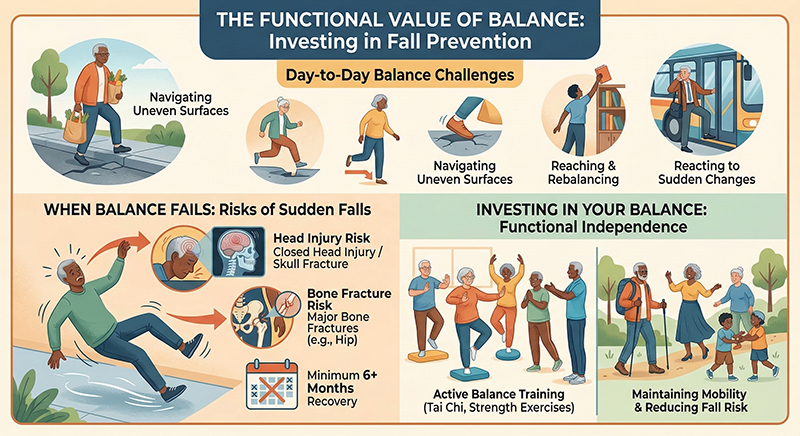
Also, I know of another person who fell, fractured her femur (thigh bone) 2.5 years ago and she is still limited compared to her pre-fall status.
The consequences of a fall not only break bones; I have treated many who tore their rotator cuff trying to catch themselves, and that is another long recovery when surgery is needed. Based not only on the potential for a life changing injury from a fall, but how that injury may require those close to you to help compensate for your limitations, not just weeks but maybe months, is another consequence that is often not seen until its staring one in the face. All of us have responsibilities that may need to shift to others from a fall, the ripple effects are many.
Due to the potential for so much damage and lifestyle disruption from a fall, there is not a more valuable area to invest one’s time than in balance training as a preventative action and for many it could be just a tune up process versus a major overhaul.
As youngsters, standing on one foot and dressing was the routine but as we start to hit the 3rd to 4th decades of life that skill could be fading due to a lack of challenge from our sedentary, flat pavement, shoe wearing world; all the opposite qualities of a child’s lifestyle. We need to put a little more “child” in our day!!
It is no understatement our bodies are undergoing many behind the scenes changes that eventually show up as some kind of loss as the decades add toward those “golden” years. Gosh, if only losing weight could be so easy.
Unfortunately, the rude intrusion of “loss” on our daily routines insidiously robs us of one of our most cherished qualities – being independent. And the rudest of intrusions is a complete fall where a bone gets fractured or maybe worse – a concussion. In any event, you are most likely in for a long recovery and your independence shifts to reliance. Very rude indeed, but if we are forward thinking, we can up our odds to not be thrown into that situation.
The trick is to begin with balance exercises that are at the right challenge and follow the right gradient.
Now if that ability to stand on one foot and get dressed has faded into the sunset long ago, a more basic start point would be needed to begin reversing the loss of something that has everything to do with not only avoiding falls but improving our enjoyments in life. Even just walking on the lawn, an uneven relatively soft surface, or a sandy beach stimulates many of our body’s muscles to work together. The softer the surface the more our balance is challenged.
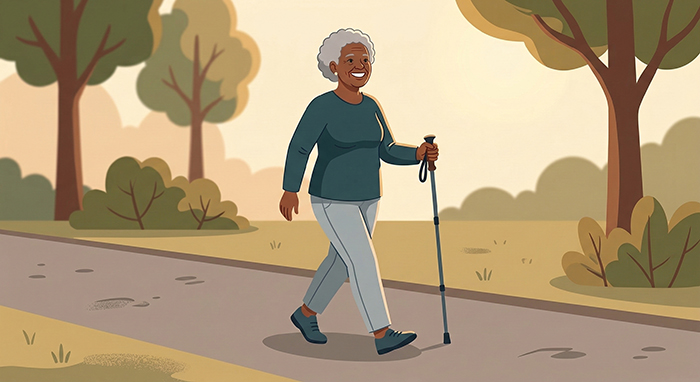
Did you know, we have over 600 muscles in our body controlling 206 bones which ideally allows us to be not only active but to do amazing things like play pickleball, hike rough terrain or even do paddle boarding (what a great balance challenge that activity is).
The beautiful thing about our muscles and the nerves that control them is they can improve with the right challenges, just like they can degrade with no challenge.
Often, it is our mind that needs to start to flex its muscle first to overcome our body’s inertia.
As the momentum begins to shift with practice into better control, one’s confidence begins to improve and the training becomes more like a game to play with ourselves. Balance training stimulates muscles in our feet right up the leg to our hips and trunk.
It not only promotes muscle strength but the coordination of these muscles to work together synergistically (one of my favorite words) to create control, stability and that great word we all love – independence.
To get the team effect of control, the body has to be worked as a team! The absolute key is to always work at a slight challenge and start where you can – safely.
And, truth be told there is not a better example of the idiom, “if you don’t use it, you’ll lose it” than with the skill of balance. Losing our control is an insidious process and demands the daily investment of grabbing our balance opportunities and putting them to work for a better future. (see the related article on balance opportunities)
There is not a more beneficial cost to reward ratio than investing in your balance as it is involved in all things standing.
When you are on your feet your balance is needed and its presence operating at a strong level can contribute to avoiding a lot of heartache, pain, and medical cost from a fall. We at Full Potential are just trying to raise your awareness on this inescapable but under recognized need. If this article has put this important ability back on your radar and you need some help getting started Full Potential PT has some excellent balance “masters” to assist you. Reach out to your doctor and prompt them to refer you.
Did you know, insurance companies like Medicare, would much rather handle the cost of balance training if you are a fall risk than the cost of you falling (doctors’ visits, surgery/drug costs, hospital stays, and sometimes being admitted to an assisted living center to recover, not to mention the pain, sleepless nights and having to be waited on). That is a lot of loss!
Don’t wait to learn the hard way that your balance is not what it used to be. The best active is to be proactive to prevent unwanted events. Get a referral from your doctor or get a consult from us, but no matter what – get going!!! You can reach our excellent front desk staff to help you get started. 616-392-2172.
To handling gravity with ease, Vince Hanneken, PT/Owner.
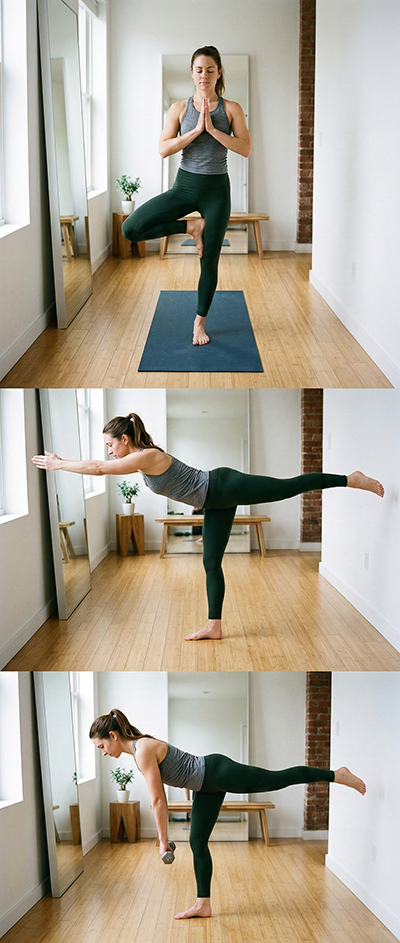
TOP 12 BALANCE OPPORTUNITY CHALLENGES
When one looks at their day, it is amazing to recognize all the things we do that have the potential to practice a balance opportunity challenge.
What do we mean by a balance challenge? It is standing on one foot, close to a surface to grab, for short periods – 5-10 seconds.
Now if you cannot even begin to hold your balance on one foot then you need some help getting started, and we can do that for you. You could have muscles that need to be strengthened individually to help in doing their share in a balance challenge.
Let’s look how easy this could be but with the idea of being safe by having something to grab as needed. Don’t create a fall risk in practicing to prevent falls!!!
- Standing at the sink doing dishes for short periods on one foot.
- Brushing one’s teeth.
- Filling up the gas tank.
- Waiting in line at the store.
- Cooking that egg or stirring the soup.
- Talking on the phone, why not do it standing with short bouts of being on one foot.
- Watching T.V. – take a break from sitting. This is one of those great opportunities to exercise as one indulges in some T.V. time.
- Ironing for those who still iron.
- Waiting on the light to change when walking. (Next to traffic pole to be safe)
- Waiting on the microwave to finish. That is a great one.
- Scrolling on your phone – make that time somewhat valuable.
- In the shower (only with a grab bar), and you can practice barefoot which is more difficult.
All these activities are common for all of us during the day and balance training does not have to be complicated nor does it need special equipment. Yet, it does need someone to take action and be aware of how frequent the opportunities are to stimulate the 600+ muscles to help us stay upright on one leg.
And truth be told, that is just scraping the surface for building a balance program where it moves from static to dynamic to something high level like standing on a paddle board but it begins with simple challenges as a start. If you want to advance your skills more than just the basics of single leg stance, this is where Full Potential can come in to advance your ability.
If you are having trouble getting started, Full Potential can help you begin with small successes and build to creating one of the most valuable assets you can have as the decades add up. See our main article for learning the ‘why’ to think prevention regarding our skill of balance.
The final word on balance is if you’re not practicing the skill as the years add up you are losing the skill. It’s only in the unique challenges of balance training that the skill becomes sustainable through time.
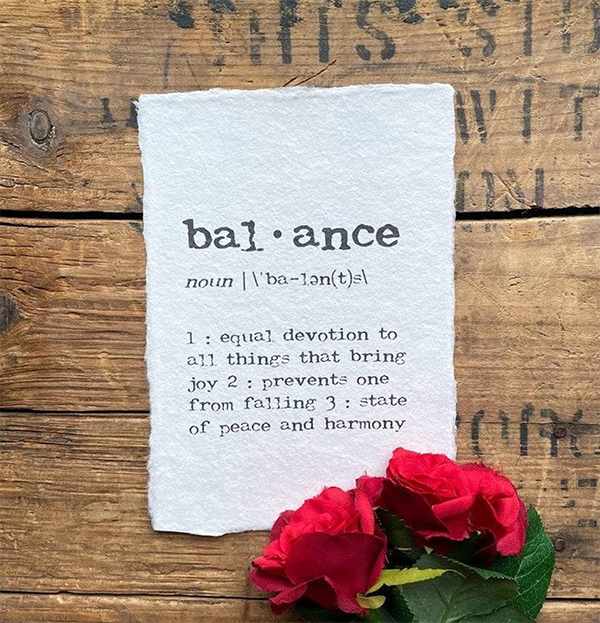
Another few words on this word – BALANCE.
For sure, a big part of the word balance relates to controlling one’s body in space. If you watched the Olympics last month, you had the chance to witness some amazing examples of staying on your feet under tough conditions. Hockey and figure skating demonstrated just how extreme this skill can be honed, yet there are so many other examples where balance in life contributes to health and a positive lifestyle.
From treating many patients over 4 decades, I have observed a huge change in our work postures with the progressive advancement of computers in business operations. Sitting for long stretches of a day at a desk is not optimal to sustain good postural balance. There is a fairly strong truism regarding the body that the form follows the function. For example, dominant postures like sitting at a desk for hours every day begin to be reflected in how our body will naturally start to hold itself, it is literally being trained into a more flexed or stooped posture.
One of the best actions for someone who sits a lot is do the opposite to rebalance their posture. An example of this would be to lay on a carpeted floor with your knees up and arms out to your side or put your feet up on a chair and assume the “chair like” posture but now on your back. This lets the shoulders sag back, lets your head retract (those heads like to get more and more forward sitting too, and cell phones don’t help either) and your spine straighten from slouching. Ten minutes a day can make a big difference to avoid the detrimental effects of sitting for long periods.
And, did you know the more slouched or forward a body gets, a sudden loss of balance makes it harder to recover and a fall more likely.
There are many other applications of this word “balance” to our day.
- Keeping a balance between work and play
- Keeping a good balance between sleep and activity
- The balance between diet and exercise to control weight
- Even keeping a balance between focusing on ourselves and helping others.
Balance in all its applications involves having control in different spheres of our life and in so doing we create a lifestyle that is more sustainable. Full Potential can help you get better at managing everyone’s constant foe – gravity. Sometimes we forget we are in a daily battle with it until it rudely causes us to fall. Check us out if you would like to start early and think prevention with a comprehensive balance program!
Frequent Falls
Case Description: Pt. is a 78 y/o female who presented to physical therapy with a ~6 mo history of falls (5 occurred in the month leading up to her starting PT). Over this period of time, she had lost her husband and was attempting to care for her home/yard and she was working part-time on her family’s flower farm. She was feeling overwhelmed with her progressive physical decline and frustrated by her falls. Most of her falls were occurring while trying to bend over to pick-up household or farm items. Once on the ground, she had been unable to get up and would have to call family members to come give her assistance. Fortunately, she had avoided any major injuries.
Objective Measures: She was seen for 10 physical therapy visits over a 2.5 month period.
| Tests and Measures | Initial Evaluation | Day of Discharge from Physical Therapy |
| Lower Extremity Functional Scale | 69% impairment | 10% impairment |
| Berg Balance Test | 44/56 (high fall risk without use of assistive device) | 53/56 (low risk for falls, even without use of assistive device |
| 30 Second Rise Test | 5 repetitions, highly labored | 10 repetitions with relative ease |
| Hip Girdle Strength (MMT) | Grossly 4/5 throughout | At least 4+/5 all planes |
Impact on Her Life: At the conclusion of her care, she had not had a fall in 2+ months and was able to transfer from ground to stand independently. She was engaging in more home/farm tasks and feeling more confident in her situation. She was very pleased with her ability to be more physically active and feeling encouraged about her future!
Summary: Physical therapy should be a first line intervention to address balance related issues limitng physical function. It is a non-invasive means to improving overall function and health related quality of life. Please consider PT referral for individuals experiencing balance difficulties or with history of recent falls. Thank you!
Sincerely,
Luke Vander Zouwen, DPT
Full Potential Physical Therapy
Ask a PT
Welcome to our “Ask a PT” feature! This is your go-to spot in the newsletter to get real answers to everyday questions about the body, movement, and feeling your best. Whether you’re dealing with an injury, wondering how to stay active, or just curious about how physical therapy works, our team of physical therapists is ready to help. Each month we’ll share responses, tips, and answers based on questions from you, so if there’s something you’ve been wondering about, don’t be shy! Send it in – we’d love to hear from you!
Recent Q and A!
Q: What’s the science behind “prehab” and does it actually help me after my surgery?
A: “Prehab,” or prehabilitation, is exactly what it sounds like: preparing your body before surgery to improve recovery afterward. Think of it as training your muscles, joints, and cardiovascular system to handle the upcoming stress.
Here’s how it works.
Surgery often causes temporary muscle loss and weakness. Strengthening key muscles beforehand helps you bounce back faster. For example, patients scheduled for knee and hip replacements who pre-hab have stronger quadriceps and hip muscles, and that translates to better mobility afterward.
Lower range of motion before surgery can slow down post-op recovery. By stretching and working on joint flexibility, the body is prepared to adapt more quickly once the surgery is done. Cardiovascular fitness also plays a role in recovery! Being in better overall shape helps your body tolerate anesthesia, stress, reduces complications, and supports faster return to your daily activities. Working with a PT before your procedure can help you remain in better shape even without full mobility.
Lastly, prehab teaches your brain and muscles how to move efficiently, improving balance, coordination, and gait mechanics. After surgery, this neural “training” helps you regain safe, functional movement more quickly.
But does it actually work? The answer is yes. Prehab is directly tied to shortened hospital stays, reduced pain and swelling, quicker return to daily activities, and improved overall function and confidence. It’s not just a trend, it’s a science backed strategy to give you a head start on recovery!
Q: I’m a beginner in the gym and I feel like I’m not making any progress. Will PT help me? Or should I try personal training?
A: First, great for you for starting! I’d wager that almost every beginner feels this way at some point. Progress isn’t always as obvious (or as fast) as we expect. The real key to the answer here is why you feel stuck.
If you’re not progressing because you’re unsure about your form, you don’t have a structured program, or you don’t know how to increase the weights or intensity, a personal trainer is likely your best next step. A lot of gyms have personal trainers on staff who are ready to assist with these common problem areas!
However, if you’re not progressing because of:
- Aches and pains
- Old injuries flaring up
- One side feeling weaker or unstable
- Feeling limited by mobility or stiffness
That’s where a physical therapist shines. A PT will assess movement quality, identify imbalances, and fix the “leaks in the system” that might be holding you back.
As a general rule- if there’s no pain or mobility issues, try personal training. If there’s any movement issues, see a PT.
And remember, sometimes the fastest way forward isn’t always doing more, it’s doing the right things better.
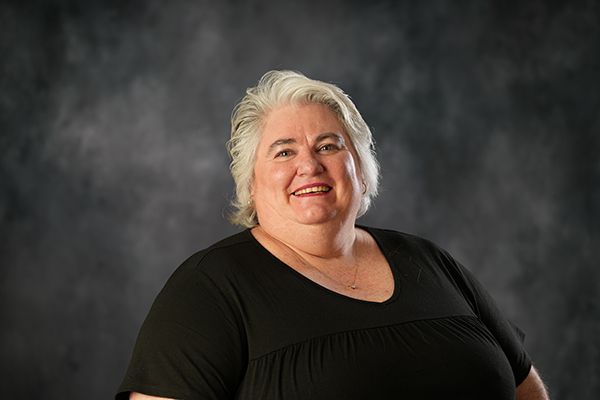
Meet Marjalize Kirsten, PT!
Marjalize completed her education in South Africa, earning a Bachelor of Science in Physiotherapy in 1992. She then relocated to the United States in 1994. She has practiced for decades in a wide range of clinical settings throughout Michigan.
Marjalize is passionate about helping patients restore their bodies to their fullest potential. She has completed numerous advanced manual therapy courses, driving her focus on the whole body, not just individual symptoms. Her care is deeply rooted in compassion, clinical expertise, and a strong foundation of faith.
Outside of the clinic, Marjalize treasures time with her close friends – her family of choice in the United States. She enjoys supporting their children and cheering them on in their many sports and activities. In her free time, she also finds joy in wood carving and playing golf.

Grilled Wild King Salmon
Ingredients
- 1 Tbsp. extra virgin olive oil
- ¼ cup leeks, white part only, finely diced
- ½ tsp. fresh garlic, minced
- 1 Tbsp. lemon zest
- ½ tsp. salt
- ¼ tsp. black pepper, coarsely ground
- 1 Tbsp. parsley, chopped
- 8 wild king salmon filet pieces (2 ounces each), skinless, boneless (Or, for a quick and simple substitute, try frozen, packaged wild salmon burgers. They can be sautéed in olive oil and garlic for a delicious, healthy, doctor-approved dinner.)
Nutritional Information: (Per serving)
Calories: (180); Fat: (1.5g); Carbohydrates: (1g); Sodium: (320mg); Sugar: (0g); Fiber: (0g); Cholesterol: (55mg); Protein: (24g)
- Prepare the grill: Preheat an outdoor grill equipped with a lid using lump wood charcoal until it reaches a steady 275°F. Clean the grates and add soaked hickory or your preferred wood to the coals for aromatic smoke.
- Mix the base: In a large mixing bowl, thoroughly combine the first seven ingredients. This will serve as the leek mixture for coating the fish.
- Prep the salmon: Remove the skin from the salmon and slice the filet into eight thin portions, ensuring you cut on a 45° bias. Toss the pieces gently in the leek mixture until evenly coated.
- Grill the fish: Place the salmon on the grill and cook, covered, for 1–2 minutes. Turn the pieces over and continue cooking for approximately one minute, or until the flesh is just lightly opaque.
- Serve: Remove the salmon promptly from the grill and serve immediately while hot.
“Therapy that works!“
“As a result of physical therapy, I am able to walk, jog, go up and down stairs, pain has improved a lot, and my range of motion is much better. Good instructions. Therapy that works! Very friendly and caring staff. I looked forward to all of my appointments.”
– Netha W.
Exercise of the Month
One Leg Balance (No Support)
(Ankles, Core, Balance)
Slowly lift your uninjured leg upward behind you so that your weight lies on the leg with the injured ankle. Hold this position for 20 to 30 seconds and gradually progress to more seconds as you get stronger.
2 Sets, 1 Rep. (Materials needed: chair)
Let’s Get You Better ASAP!
Don’t let pain dictate your life. Take the first step towards reclaiming your mobility and well-being with our expert support. Start your journey to a healthier you today.