

How heavy is your head?
How physical therapy helps with neck pain

Vincent Hanneken, PT/Owner
By Vincent Hanneken, PT/Owner
You probably do this every day, maybe without even thinking about it: looking in the mirror. When you look, you can see just how the human head is positioned on the trunk. The side view of the neck is even more revealing, though you may need to have someone take a picture to see what is happening. Most likely that photo will reflect the same view that the majority of us will see if we looked at our profiles – the position of the head and neck migrating forward, potentially even moving ahead of our trunk. The sooner we all become aware of this tendency, the more we can do to correct it! So, read on and learn about an important topic for good neck health.
“Something most people don’t realize is that the head is a significantly heavy piece of equipment, usually between 5-11 pounds.”
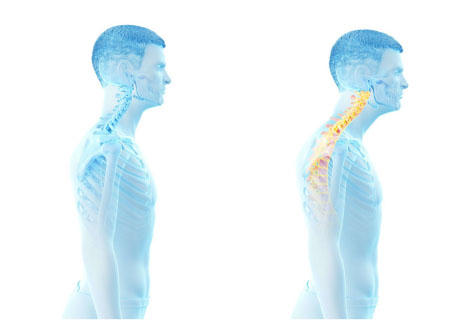
Something most people don’t realize is that the head is a significantly heavy piece of equipment, usually between 5-11 pounds. (For reference, a two liter of soda weighs about 5 pounds, a gallon of milk weighs 9 pounds, and an average upright vacuum weighs around 11 pounds!) As it moves subtly forward over time, the weight of our head is experienced more and more negatively on the seven spinal segments that make up our neck and upper back.
At first, 5-11 pounds may not sound like a lot of weight, but as it moves forward from a vertical position and consequently more into gravity, that 5-11 pounds starts to exact more stress on important tissues – tissues you would like to protect if you were aware of what was happening! Our joints, disks (the spacers between the vertebrae), ligaments, nerves and muscles all feel the stress of the neck’s weight. If they could verbally talk, they would likely echo what our moms often said: “Sit up straight, or you’re going to look like your grandpa!”
What is interesting about the creeping forward head posture (FHP) is that the design of our neck joints almost invites our head to move forward of our center line. The center line should go through the center of the ear. These joints are angled to allow our head to more easily fall forward, and if we combine this with how our eyes are perpetually looking ahead to see, it becomes a natural invitation to draw our head forward.
Along with the natural posture of the head, certain sitting environments also encourage FHP. If you are sitting at a computer all day, the motion of the head is minimal and limited, and it becomes a perfect recipe for cooking up a forward head posture. The neck joints and tissues are working too intensely to comfortably cope because the head has migrated forward. What often begins as an insidious intrusion of stiffness and achiness can grow over time into a nagging problem.
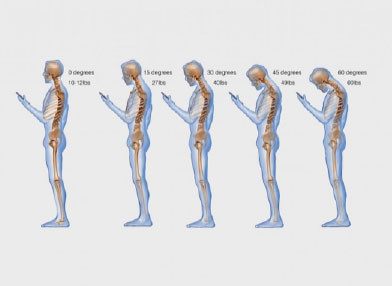
The computer is not the only technology to affect our neck posture! The phone has become our third appendage, and in the picture below you can get a sense of how stress builds on the neck as the degree of forwardness advances. That 5-11 pounds starts to create some compound interest of the negative kind on our mid and lower neck. These are the segments of the cervical spine where the majority of surgeries take place.

“Phone scrolling can pull one’s attention into a prolonged zombie-like state”
Phone scrolling can pull one’s attention into a prolonged zombie-like state, all while one’s neck is out of center and in a coping mode. This is often a problem for teenagers, and while such angles can be tolerated when young, it begins to build a problem with no easy solution for the future.
More than technology impacts our neck posture. There are many jobs where you look down for the majority of the day! As a PT I am always looking down when working on a patient – surgeons may say the same thing. Or how about a production line worker or cashier, always looking down at the belt or the scanner. No matter the job, chronically looking down in any instance trains the neck to be eventually stuck in some degree of forward head posture. And to take it one step further, those who are typically slouched in their posture do not sit up straight to look ahead, but lift their chin. Now we have the perfect dual stress- forward head posture with backward cranial rotation. This puts notable tension in the muscles just beneath the skull, muscles who are often responsible for headaches. These small muscles are now called upon to do a big job and pull the 11 pound bowling ball (that feels like 25 pounds now!) up to see ahead.
Now in contrast to what the average adult head position looks like, look at the way babies position their necks. Once they can sit up and support themselves, usually around 6 months, notice how they hold their head. It is amazing! They are sitting with a straight spine, they use their upper neck to flex, and they look down with their eyes. This is just the opposite from an adult!
Babies use their eyes first because they do not know what is in front of them. They lead with their eyes and then the neck follows to support the motion. This is great for the eyes as those muscles need to be used too and we don’t often employ them properly in our movement patterns. Eyes can give us 20-25 degrees of visual field gain when used correctly, which means less work for the neck. Babies do this instinctively, but as adults we often keep our eyes stationary and use our necks to move our eyes around, which only adds to the heavy load our neck muscles and joints are already carrying.
How do you know if you are developing a forward head posture? Try the screening test in this newsletter. If the FHP test is quite positive (1-2 inches or more), action is necessary to prolong the health of your upper back and neck. Forward head posture only serves to increase existing neck pain, or may even be the root cause of the pain. Thinking preventatively and acting early can be a very good investment of your resources and often prevents much more invasive solutions in the future.
“It is not fun to live with a painful neck. And those with neck pain can attest – a painful neck teaches us to realize just how often we use it!”
Education, hands-on techniques, and exercises are three essential tools in correcting or preventing FHP. Full Potential is well equipped to help you better manage this condition with all of the above. It is not fun to live with a painful neck. And those with neck pain can attest – a painful neck teaches us to realize just how often we use it!
Forward head posture doesn’t fix itself, but that doesn’t mean it’s unfixable. Whether you’re already feeling the effects or just want to stay ahead of the curve (no pun intended!), now is the time to take action. At Full Potential, we specialize in helping people just like you restore healthy posture, relieve tension, and prevent future discomfort. Ask your doctor for a referral or simply schedule a free consultation to get started.
Don’t wait until the pain sets in! Keep your head on straight and start taking care of yourself today.
To happy necks,
Vince Hanneken, PT
Tom’s Recovery
“I came in with a lot of lower back pain. After 6 weeks of physical therapy and learning stretches, the back pain has subsided considerably and the movement has come back without the pain. I enjoyed learning the stretches and having the therapist work with me on getting the body lined up. As a result of physical therapy with Full Potential, my problem improved 100%.” – Tom A.
3 Habits for Better Posture
If you’re ending your day with headaches, a sore neck, or back pain, poor posture may be to blame. Targeted exercises are the most effective in correcting posture, but there are other habits that can encourage better posture and assist in preventing FHP! Small daily habits play a big role in how your body feels at the end of the day. Here are 3 simple habits you can pick up to keep your muscles refreshed and your body aligned:
- 1. Switch sitting positions – Avoid staying in one posture for too long. Shifting positions regularly keeps your muscles engaged and prevents you from stiffening up.
- 2. Take brief walks – Getting up once an hour for a quick walk around your space or down the hall can significantly boost your circulation, reset your alignment, and energize both your body and mind.
- 3. Gentle stretching – As you work on improving your posture, you’ll start engaging muscles that aren’t used to the extra work. Light stretching throughout the day can reduce tension and soreness and also help realign your posture – a win win!
Try working these small but powerful habits into your routine. You may be surprised at how quickly you feel the difference!
If you spend long hours at a desk, spend time glued to your phone, or if you look down constantly while you’re at work, you might be developing Forward Head Posture (FHP). FHP is a sneaky habit where your head creeps forward past your trunk, straining your neck, spine, and even your mood!
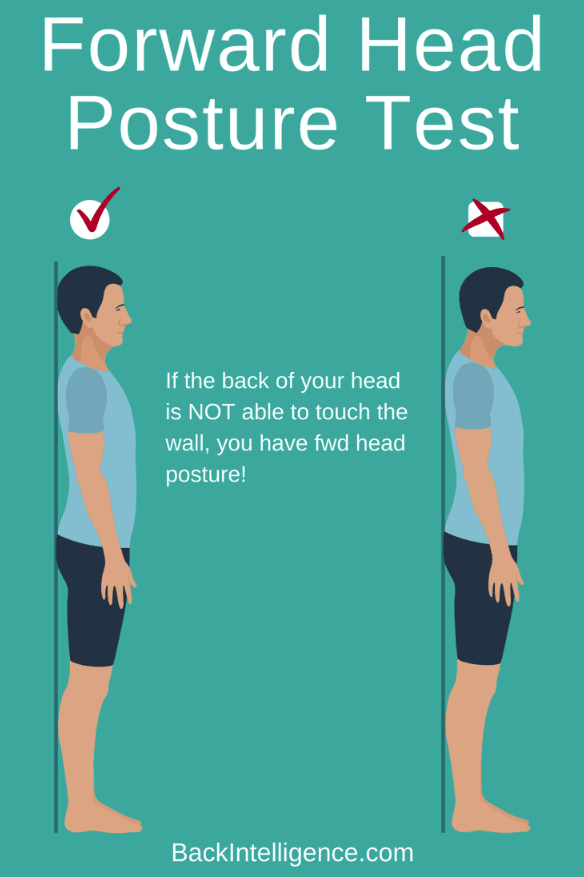
The good news is you can check for FHP in under 2 minutes and right from home. Try this quick screening test to see where you stand – literally!
1. Back up to a wall so your buttocks and shoulder blades touch.
2. Bring your chin down to level.
3. Slowly retract your head and stop at the first resistance.
4. Do not force your head back as you can strain your neck or upper back.
5. Notice the distance in inches between the back of your head and the wall.
If you are not able to complete this task or the distance between your head and the wall is significant, you may have FHP. Talk to your doctor about a referral or schedule a consultation with Full Potential to learn what steps to take next!
We are here to help you with neck pain. Not sure if you need help? That’s easy – come in for a FREE CONSULTATION and we can talk, test to identify deficits and discuss what may be needed. We also offer consultations by phone, just call 616.324.0353.
Ask a PT
Welcome to our “Ask a PT” feature! This is your go-to spot in the newsletter to get real answers to everyday questions about the body, movement, and feeling your best. Whether you’re dealing with an injury, wondering how to stay active, or just curious about how physical therapy works, our team of physical therapists is ready to help. Each month we’ll share responses, tips, and answers based on questions from you, so if there’s something you’ve been wondering about, don’t be shy! Send it in – we’d love to hear from you!

New 5 Star Reviews
At Full Potential Physical Therapy, we’re honored to be part of your healing journey and your feedback means the world to us! Here’s what some of our recent patients had to say:
It was great!
“It was great, Vincent is hands down the best PT I’ve met!”
Awesome one-on-one care with Luke!
“Awesome one-on-one care with Luke! Would recommend their physical therapy services to anyone looking for personalized care in a pleasant environment with great staff!”
Stretching exercises are really helpful.
“My therapist is a genuinely caring person. He makes sure I’m doing well and adds strengthening exercises as needed. Stretching exercises are really helpful.”
I would highly recommend this physical therapy office!
“The staff is so friendly and helpful! I was greeted with smiles every time I came in. Dr. Luke is very easy to talk to and encourages you to keep moving forward. He or Kristin always were so helpful at my appointments! They truly cared about how I was doing and how they could help me overcome any issues or concerns I had. I would highly recommend this physical therapy office!”
Your reviews help others find the care they need and keep us motivated to deliver our best every day. If you’ve had a positive experience, we’d love to hear from you!

Fresh & Healthy Salsa Recipe
- 4 ripe tomatoes
- 1 red onion
- 3 garlic cloves
- 1 jalapeno (stemmed and seeded)
- 1/3 cup fresh cilantro
- 3 tbsp fresh lime juice
- 3 tsp ground cumin
- 1 1/2 tsp salt
- 15 oz crushed tomatoes (1 can)
- 4.5 oz diced green chiles (1 can)
Place the fresh tomatoes, onion, garlic, peppers, cilantro, lime juice, cumin, and salt in a food processor. Pulse until the contents are blended to desired consistency. Pour in the crushed tomatoes and green chiles. Puree until mostly smooth. Refrigerate until ready to serve.
Exercise of the Month
Dead Bug
(Core, Lower Back)
Lie down on your back with your arms by your sides, your knees bent to 90-degrees, and your feet on the floor. Raise one arm up straight and one knee up towards the ceiling at the same time. Your arm should stay straight and be pointing straight up at the top and your knee should be at 90-degrees and be pointing straight up at the top. 3 Sets, 10 Reps.
Let’s Get You Better ASAP!
Don’t let pain dictate your life. Take the first step towards reclaiming your mobility and well-being with our expert support. Start your journey to a healthier you today.